Monday, February 7, 2011

Holzmaden

For those not in the know (this group, much to my dismay, includes pretty much everybody), Holzmaden is important. Rather than being an unheard of village over an hour and 6 transit zones southeast of Stuttgart Mitte using public transportation, it could in fact be regarded as the mother ship for geeks such as myself. Holzmaden plays a disproportionate role in what we know of marine paleobiology in the Lower Jurassic, and even the Mesozoic. For instance, evidence that ichthyosaurs had dorsal fins, like dolphins, is comes only from Jurassic rocks in southwest Germany, mostly from quarries in Holzmaden.
Ichthyosaur - Urweltmuseum Hauff Gallery, Holzmaden Germany

Historically, the major industry in Holzmaden was quarrying. The local shale was used for building, finishing (e.g. counter tops and flooring), and for the manufature of cement and gravel. The rock layer used is also highly fossiliferous. Over the past 200 years, thousands of fossils have been extracted and prepared, and sold, exchanged and gifted to museums and private individuals all over the world. Aside from my personal favourite of ichthyosaurs, other wonders include plesiosaurs, marine crocodiles, fishes, ammonites, belemnites with preserved soft tissue and, most famous of all, gallery-sized slabs of crinoids. The number of quarries has sadly dropped precipitously, which is unfortunate in some ways. Holzmaden boasts two paleontology museums, conveniently located right across the street from each other. Not bad for a village of 2000 people. Also included: scenic views of the Schwäbische Alb. Not included: much in the way of dining options. For a visit, take Stuttgart S1 Kirchheim to the terminus, then a bus. I know people other than me secretly get thrills out of riding S-Bahn trains to the termini. All the more reason to go to a town few have ever heard of. Your friends will be totally jealous.

Sunday, January 30, 2011

Killesberg

Stuttgart has a fairly extensive park system. For some reason, I never ventured out of the central part, but today I explored what things are like to the west of the museum. Turns out it's really nice. The neighbourhood is nice too. Stuttgart names every little tiny segment of park something different, but generally we'll call the area in question Killesberg. While Schloßgarten/Rosensteinpark go for Greek and Roman statuary, Killesberg goes for weird modernist sculpture.

Pac-man emerges from his underground lair
I don't know why I found this landscaping attempt so inspiring. All the trees in one planter . . .
The Triassic: now with cross-bedding!
I probably just liked Killesberg so much because apparently it's a reclaimed quarry (no, I didn't know when I decided to walk there). The back half is a giant cliff made of Triassic-aged redbeds.

Saturday, January 29, 2011

Recycling madness

I had heard so many stories about how seriously recycling was taken in Germany that I was expecting a magical and well-oiled system. The reality was . . . absurdly complicated.

The recycling program was first introduced to me when I was in Schwäbisch Hall – in the residence, there was a sign over the recycling bag explaining essentially that tetrapaks and items marked with the special recycling symbol could go in. Bottles were supposed to go back to the store for a refund. I was very literal, and didn't recycle anything because absolutely nothing I bought was marked with the symbol.

When I moved to Stuttgart, I was forced to switch grocery stores and therefore brands. I discovered that a few companies did indeed label packaging with the recycling symbol, and if I thought about it logically, almost everything could be recycled (if yogurt container A has a recycling symbol and B doesn't, they're probably both recyclable because they're made of the same kind of plastic. Are the lids recyclable? Still haven't figured that one out). It turned out the whole symbol system was totally misleading, because aside from failure to label most items that can be recycled, some of the items labeled with the symbol are not recyclable using the same system (e.g., glass, which has to be sorted by colour and dropped off separately at inconvenient and distant drop boxes scattered throughout the city). After I had lived in Stuttgart for almost two months, the city finally sent everyone a brochure explaining how recycling worked along with the pickup schedule. It is still a mystery to me where one might purchase the magical plastic bags recyclables are supposed to be put into. Not the grocery store, the convenience store or the drugstore – I spent a lot of time looking. Probably somewhere far away with very bad hours. Luckily I inherited a small supply when I moved in to my new place after Christmas.

Some questions that really puzzle me are A) why they don't give everyone the educational brochure and schedule when they first move in? All foreigners have to register with the city upon the first week of arrival anyways; it would be awesome to get some useful information at the same time. Possibly a stash of the Official Yellow bags too; B) it clearly is not law that all recyclable packaging has to be labeled with the symbol. Since Germany is quite enthusiastic about legislation, from what I've seen, this seems like a bit of a no-brainer.

Who knew household waste was so complicated?

View from my office before the snow melted

Saturday, January 22, 2011

Birds

Birds are great, but difficult to photograph, especially on the way to work when I don't have time to stand still and wait for them to come close. The nice part is that the birds that live in the park in Stuttgart don't seem to migrate anywhere. They disappear when the weather drops below zero, but are back as soon as it warms up so they couldn't go very far. Aside from the ever present pack of mallards and pigeons (boring city birds), there's a random cormorant, a great blue heron, a pair of storks,
The city must stock the pond, because the storks aren't eating bread crumbs all winter

"song birds" – by this point it should be clear I've failed to locate an English language guidebook to birds of southern Germany. The initial goal was to photograph said 'songbirds' and ask for help with the ids, but the photography stage has not met with unparalleled success.
Also 20 million crows. I don't know if they're the same species as in North America. German people call them ravens, but this might be a translation issue. From a North American perspective, they're certainly more crowlike than ravenlike. They're kind of cool because they hybridize with an eastern species, and so some of them have random white feathers in their wings and tails. It gives them a magpie-esque look.
Crow vs. raven? The mystery continues

And, staple of parks the world over, Mute Swans!

Tuesday, January 18, 2011

Stuttgart TV tower

In an effort to participate in all of the tourist attractions the city of Stuttgart has to offer, I made a visit to the TV tower.


While this tower is definitely not the tallest TV tower out there, Stuttgart has gone for the 'oldest' prize, and claims this TV tower is the prototype after which all subsequent TV towers (e.g., the CN tower) were modeled. There were also some extremely retro looking army green rotary telephones in the ticket vending booth that reinforced this claim.

Supposedly on a clear day you can see the Alps from the observation deck, which sounded great to me. However, it turns out that air quality isn't a strong point of the region - even on a clear January day, it's blanketed in smog. The furthest I could see was the Schwäbische Alb, only 100km to the south. It was pretty though, and with the coffee and cake stop afterward, made for a delightful Sunday afternoon.

View towards the south, the hazy looking highland is the Schwäbische Alb. But the fields are still green in January!
Low angle winter sunlight

Monday, December 20, 2010

Happy holidays!

Happy holidays everybody! The blog will take another short hiatus while I return to by birthplace for Christmas. Back in the New Year with more insightful commentary into random tourist topics. Did you know that Stuttgart is (unfortunately for me) one of the few cities in Germany where rather than employ a superintendent, the tenants take turns cleaning the sidewalk and taking out the trash from large apartment buildings? It snowed copiously during my week, just so I could have this experience.

Altes Schloss, Stuttgart

Thursday, December 16, 2010

Weihnachtsmarkt

My favourite part of Germany so far! From the end of November until a few days before Christmas, an outdoor market is set up dedicated to all things Christmas. There are stalls selling ornaments, gifty items, candy, gingerbread, chocolate covered fruit, Christmas-themed tableware, Glühwein (spiced wine) and traditional Schwäbisch street food (mostly different types of sausages). The one downside is that the market is super crowded and so gets a bit claustrophobic if you're trying to walk around. Stuttgart has one of the larger Christmas markets in Germany, and it attracts busloads of tourists. Now if only it were a bit warmer . . .

'Official' entrance to the market right by where the tour bus parking lot is.


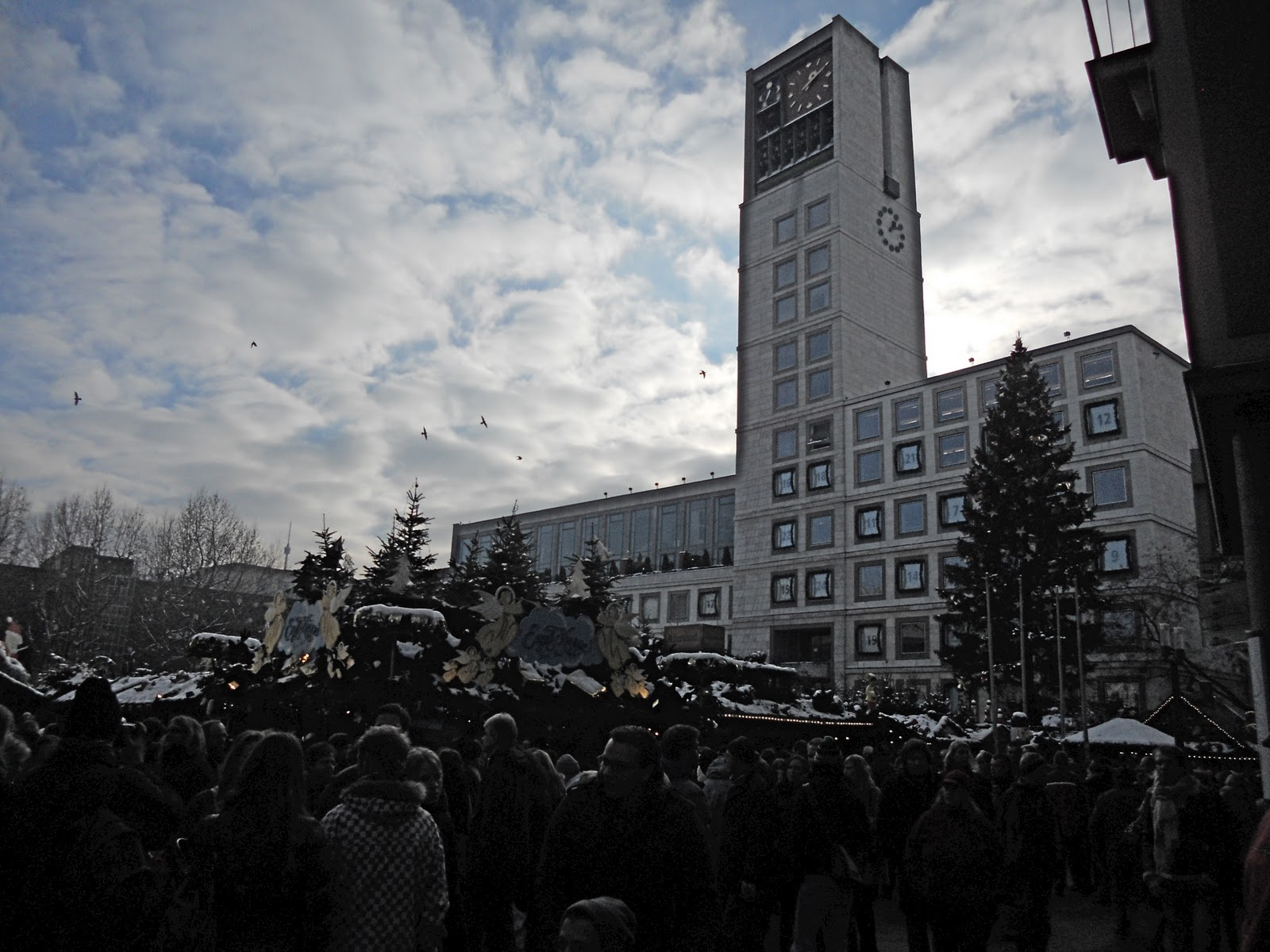
Stuttgart Rathaus (city hall) overlooking the main marketplace. The enormous decorated conifer was actually cut down and brought to Stuttgart just for this occasion.

The rooves of all the stalls are decorated. I was at another Christmas market in the Stuttgart suburb of Esslingen where one of the stalls was decorated with taxidermied musk deer - slightly unsettling.